- Jinhua Sigma Industrial And Trading Co., Ltd.
- 86-13566763606
- info@jhsigma.com

The Best Industrial
Solution Provider
What Outdoor Furniture Lasts the Longest? A Quality Buying Guide
Well-made teak, properly finished aluminum, and quality HDPE furniture are strong candidates for long-term outdoor use. However, no material lasts longest in every setting. To judge quality, check the frame, joints, finish, hardware, cushions, and replacement options—and ask whether the product suits your climate and intended use.
A beautiful product photograph tells you how furniture looks when it is new. It tells you much less about how the joints are built, how cushions handle moisture, or whether replacement components will be available.
For a private patio, villa, hotel, or resort, the better question is: Which furniture is built appropriately for this location, and what evidence supports that choice?
Which Outdoor Furniture Materials Are Worth Considering?
Start with the structural material, then evaluate how the complete product is made. A material name alone cannot establish the quality of a finished sofa, chair, or dining table.
Teak: A Natural Wood Option with a Changing Appearance
Teak is worth considering when you want natural wood and are comfortable with its appearance changing outdoors. Untreated teak gradually develops a silver-gray patina. That color change should be distinguished from a structural problem. Gloster’s care guidance also explains that teak does not necessarily require oiling; care depends partly on the appearance you want to maintain. gloster.com
When assessing teak furniture, ask:
- Is the wood species clearly identified?
- How are the joints constructed and secured?
- Are the surfaces and edges smoothly finished?
- What changes in appearance should you expect?
- What care instructions apply to this particular product?
Do not judge wood quality by color alone. A surface finish can change its appearance without explaining the material or construction underneath.
Powder-Coated Aluminum: Check the Frame and the Finish
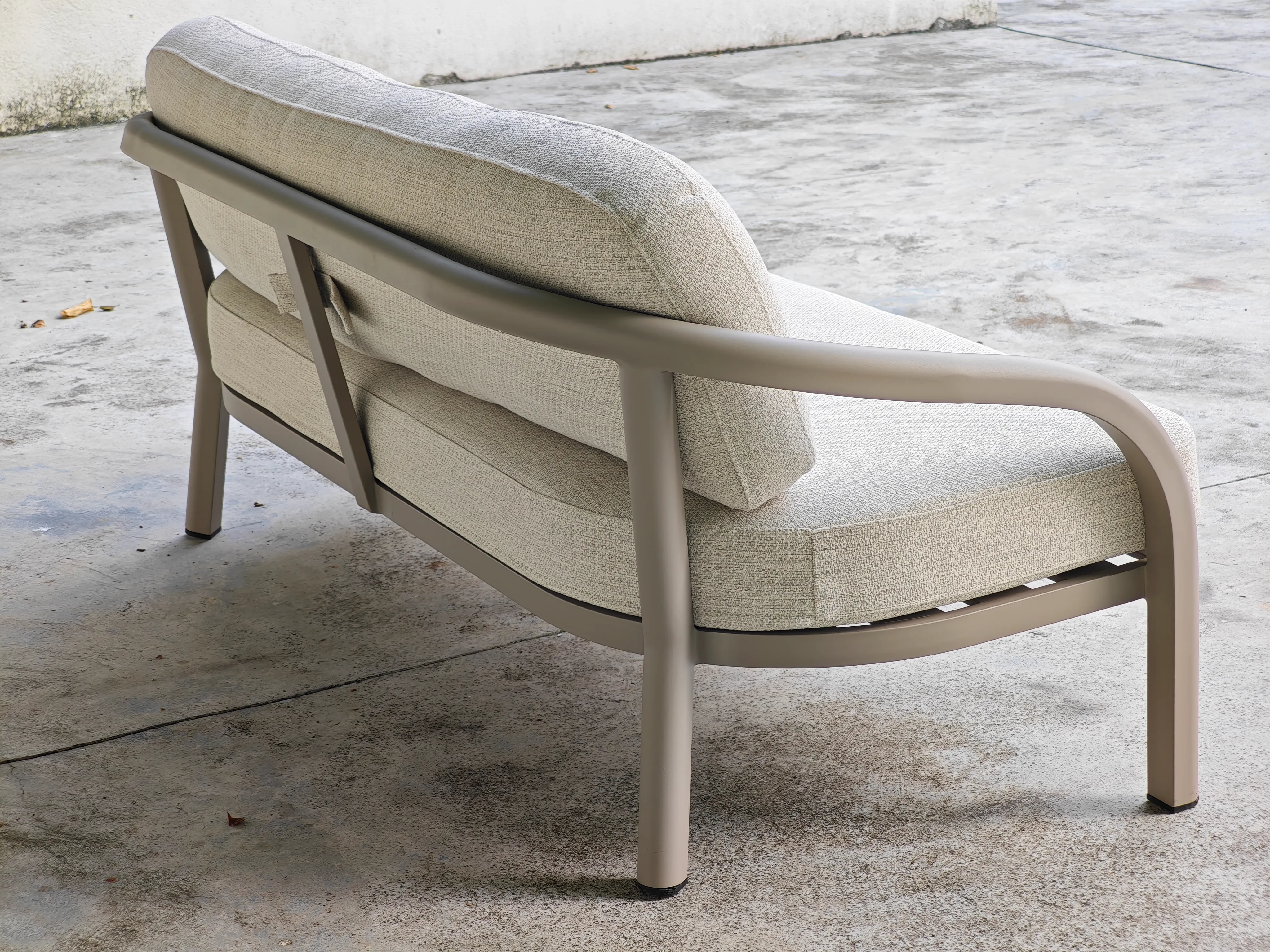
Aluminum offers a useful combination of low weight and corrosion resistance. However, a durable aluminum furniture frame still depends on its structural design, connections, and surface treatment. gloster.com
Powder coating is not a single, uniform quality level. The Powder Coating Institute identifies surface preparation and coating selection as important factors in performance, including corrosion protection and outdoor UV stability. Powder Coating Institute
Before buying, ask about the frame construction, coating process, hardware, and recommended care. Inspect corners, joints, undersides, and exposed edges—not just the most visible surfaces.
HDPE: A Low-Maintenance Alternative to Compare
HDPE, or high-density polyethylene, is another material worth comparing, especially when easy cleaning is a priority. For example, POLYWOOD identifies HDPE as the material used in its lumber and provides soap-and-water cleaning guidance. These statements concern that manufacturer’s products; they should not be treated as proof that every HDPE product performs identically. polywood.com
Check the complete construction, including the supports, fasteners, comfort, and product-specific care instructions.
Woven Furniture: Look Beneath the Weave
“Wicker” describes a woven construction rather than a complete material specification. Ask what the strands are made from and what supports them underneath.
A useful specification should identify both the weaving material and the frame. For example, Gloster documents polyethylene weaving over a powder-coated aluminum frame for its woven furniture. That combination illustrates why the visible surface is only part of the product. gloster.com
For rope or woven furniture, request close-up photographs of the attachment points, underside, and supporting frame.
Outdoor Furniture Material Comparison
Use this table to guide your questions rather than as a universal durability ranking.
Material or Construction Why Consider It? What to Verify Before Buying
Teak Natural wood appearance that can weather to a silver-gray patina Wood identity, joint construction, surface finishing, and care expectations
Powder-coated aluminum Low weight and corrosion resistance Structural design, connections, surface preparation, coating, and hardware
HDPE An option to compare for straightforward cleaning and maintenance Material specification, supports, fasteners, comfort, and care guidance
Synthetic woven furniture Woven appearance with different frame and strand combinations available Exact weaving material, hidden frame, attachment points, and repair options
Rope furniture Another construction option for outdoor seating Rope specification, supporting frame, attachment method, and intended exposure
A strong frame does not automatically mean a long-lasting complete product. Evaluate the upholstery, hardware, and service options separately.
How to Judge Outdoor Furniture Quality Before Buying
1. Ask for Specific Materials, Not Just Marketing Descriptions
Descriptions such as “premium,” “all-weather,” and “heavy-duty” are starting points for questions.
Ask the supplier to identify the materials used for the:
- Main frame.
- Tabletop or seating surface.
- Weaving or rope.
- Upholstery fabric.
- Cushion filling.
- Fasteners and other hardware.
For a custom order, include the approved selections in the written specification. This also gives you a reference when checking the delivered furniture.
2. Inspect Joints, Connections, and Stability
Ask for detail photographs or a video showing the furniture from several angles, including underneath.
Look for uneven connections, visible gaps, loose components, rough edges, or wobbling on a level surface. Ask how the main load-bearing connections are made.
Weight alone is not a reliable quality test. A heavier product is not automatically better, and a lightweight product is not automatically poorly made. The design and construction need to suit the intended use.
3. Review the Finish Beyond the Front View
Inspect the finish around corners, joints, edges, and less visible surfaces.
Check for obvious damage, peeling, missed areas, or unexpected inconsistencies. For a custom finish, approve a physical sample where practical and keep a record of the agreed color and texture.
A visual inspection can reveal defects, but it cannot establish a coating’s long-term performance. If a supplier claims a particular test result, ask for the relevant report and confirm which product or finish it covers.
4. Evaluate the Whole Cushion
Ask about both the cover and the filling. A fabric’s water resistance does not tell you how quickly the complete cushion will dry.
For example, Sunbrella’s outdoor cushion guidance distinguishes highly water-resistant fabric from fully waterproof construction. Do not assume that a recognizable fabric name means every cushion can remain exposed to prolonged rain. Buy or DIY With Confidence
Useful questions include:
- What is the exact fabric specification?
- What filling is used?
- Are the covers removable?
- How should the cushion be cleaned and dried?
- What storage or covering is recommended?
5. Ask About Replacement Parts and Written Support
Before ordering, find out whether cushions, covers, glides, hardware, or other components can be purchased separately.
Ask which parts are replaceable, how replacements are specified, and what happens if a model is discontinued. Also request written warranty terms, including care requirements and exclusions.
Replacement availability should be confirmed for the actual order rather than assumed from a general service statement.
6. Match the Product to Its Location
Tell the supplier where and how the furniture will be used.
A covered residential patio, an exposed coastal terrace, and a busy resort pool area have different requirements. Share information about rain exposure, sunlight, proximity to the sea, cleaning practices, storage, and frequency of use.
For hospitality projects, also ask whether the proposed product is intended for commercial use and request evidence relevant to that claim.
A Practical Pre-Purchase Quality Checklist
Check Evidence to Request Reason to Ask More Questions
Material identity Written component specifications Only broad descriptions such as “metal” or “outdoor wood”
Frame and joints Underside photographs, connection details, and inspection video Important structural details are not shown
Finish Sample, process information, and relevant reports if claimed Performance claims without supporting information
Dimensions Product dimensions or final approved drawings Missing measurements or unclear reference points
Cushions Fabric and filling specifications, cleaning guidance Fabric name given without cushion construction details
Replacement support Written parts availability and ordering process No clear answer about replacing worn components
Warranty Written coverage and exclusions Verbal promises without defined terms
Frequently Asked Questions
How Many Years Should Outdoor Furniture Last?
There is no reliable lifespan that applies to all outdoor furniture. Material specifications, construction, exposure, maintenance, and intensity of use all affect the outcome.
Ask suppliers to explain any lifespan claim and its conditions. A frame, finish, cushion cover, and filling may also need attention at different times.
Is Teak Better Than Aluminum?
Neither is automatically better for every project.
Teak is worth considering for its natural wood character and changing appearance. Aluminum is worth comparing when low weight and corrosion resistance are priorities. In either case, examine the product’s construction, finish, care requirements, and suitability for your location.
Does a Higher Price Guarantee Better Quality?
No. Price alone does not establish durability.
Compare products using the same criteria: materials, construction, finish, upholstery, dimensions, and written support. Ask what accounts for the difference in price and what evidence supports the claimed benefits.
What Should I Ask an Overseas Furniture Supplier Before Ordering?
Request clear material specifications, detailed photographs, dimensions, care guidance, and written support terms.
For custom furniture, confirm the final drawings, finish references, and any agreed tolerances before production. These records provide a shared basis for reviewing the delivered products.
Discuss Your Outdoor Furniture Requirements with SIGMA Furniture
SIGMA Furniture—Jinhua Sigma Industrial And Trading Co., Ltd.—is based in Jinhua, Zhejiang, China, with more than 20 years of furniture research, development, and manufacturing experience.
When discussing your outdoor furniture project, share your location, exposure conditions, layout, intended use, and preferred materials. Ask for the specifications and care requirements of the proposed products so you can compare your options clearly.
Visit SIGMA Furniture to discuss furniture requirements for your patio, villa, hotel, or resort.

Contact US
Product Information
Quantity
Unit
Piece
Support order samples, customization, wholesale direct, and complete payment. If the product you look for does not have corresponding customized content, pls fill out the form below to contact us, and we will reply ASAP.