- Jinhua Sigma Industrial And Trading Co., Ltd.
- 86-13566763606
- info@jhsigma.com

The Best Industrial
Solution Provider
Can I Replace Outdoor Cushions and Parts Instead of Buying a New Set?

Short answer: Yes. If the main frame is stable and in good condition, you can often replace outdoor cushion covers, foam inserts, complete cushions, feet, end caps, connectors, fasteners, slings, rope, or selected woven sections instead of buying an entirely new furniture set. Replacement is usually most practical when the original dimensions and specifications are available and the damaged component can be removed safely.
However, replacement is not always the right solution. Furniture with cracked structural frames, severe corrosion, unstable joints, widespread material failure, or unavailable safety-critical parts may need professional repair or full replacement.
Professional Advice: Outdoor cushions and many non-structural furniture parts can often be replaced individually. Check the frame first, identify the exact component, and provide the supplier with the order number, photos, drawings, measurements, material, finish, and attachment details. Replace the complete set only when the structure is unsafe, deterioration is widespread, or compatible parts are unavailable.
When Does Replacing Cushions or Parts Make Sense?
Replacement is worth considering when:
-
The frame is stable, level, and free from serious cracks or corrosion.
-
The furniture still fits the space and meets the buyer’s needs.
-
Only cushions, covers, feet, hardware, rope, wicker, or another limited component is worn.
-
The original supplier, model number, order documents, or drawings are available.
-
A replacement can be matched safely to the original construction.
-
The replacement cost and expected service life are reasonable compared with buying new furniture.
For a coordinated villa, hotel, or resort project, replacing selected components can also preserve the original layout and visual consistency without changing every furniture item.
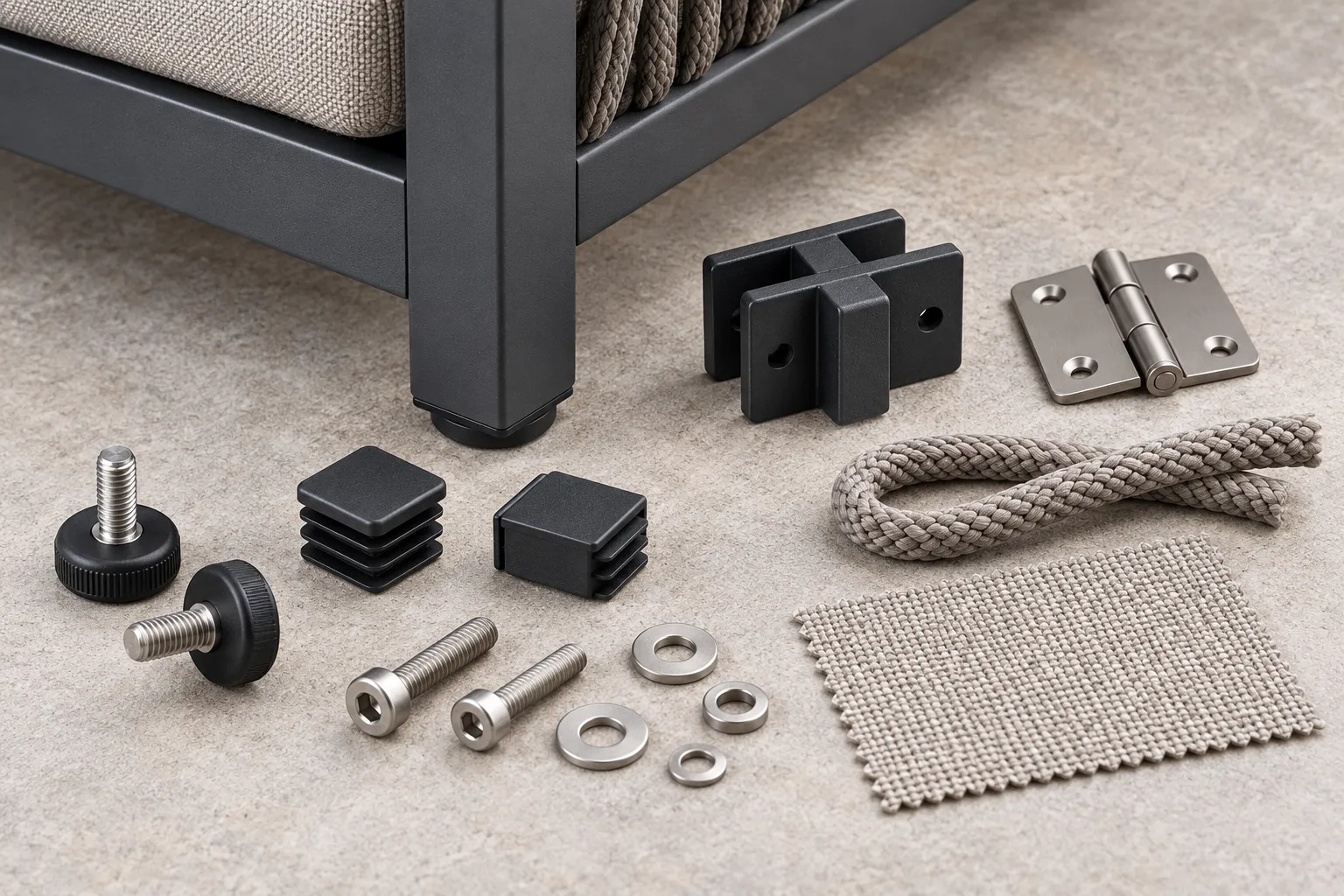
Which Outdoor Furniture Components Can Commonly Be Replaced?
| Component | Often replaceable? | What to verify |
|---|---|---|
| Cushion covers | Yes | Finished dimensions, fabric, zipper, piping, seams, attachments |
| Foam inserts | Yes | Shape, thickness, firmness, layers, drainage and ventilation |
| Complete cushions | Yes | Seat or back position, shape, size, corner radius, fixing method |
| Adjustable feet and glides | Often | Thread size, stem length, base diameter and load suitability |
| Plastic end caps | Often | Tube profile, inside dimensions, insertion depth and color |
| Bolts, screws and washers | Often | Exact size, thread, grade, material and corrosion suitability |
| Modular connectors | Often | Frame profile, orientation, spacing and locking method |
| Sling fabric | Sometimes | Pattern, tension, attachment channel and frame compatibility |
| Rope or woven sections | Sometimes | Material, diameter, color, weave pattern and fixing method |
| Tabletop panels | Sometimes | Size, support points, edge detail, weight and fixing system |
| Reclining or moving hardware | Sometimes | Exact mechanism, load, mounting points and safety requirements |
“Replaceable” does not mean that any generic component will work. Parts must match the furniture’s construction and intended outdoor environment.
Replacing Outdoor Cushions: Cover, Foam, or Complete Cushion?
There are three common levels of cushion replacement.
1. Replace Only the Cushion Cover
This is suitable when the foam still provides even support and dries correctly, but the fabric is faded, stained, torn, or no longer matches the design.
Before ordering, check:
-
Finished cushion length, width, and thickness
-
Corner shape and radius
-
Zipper length and location
-
Piping or welt detail
-
Ties, hook-and-loop straps, clips, or non-slip backing
-
Seam position and drainage direction
-
Fabric color, texture, and outdoor performance specification
Do not assume that a cover ordered from only the overall length and width will fit. Even small differences in thickness, corner shape, or seam placement can cause wrinkles or excessive tension.
2. Replace Only the Foam or Inner Construction
Replace the inner material when the cover is still usable but the cushion has become flat, uneven, slow to recover, or uncomfortable.
Foam replacement should consider more than thickness. Ask about the foam type, firmness, layered construction, fiber wrap, protective liner, ventilation, and drainage method. A very soft insert may look full but provide inadequate support; an overly firm insert may not fit the existing cover correctly.
3. Replace the Complete Cushion
A complete replacement is often the most reliable choice when both the cover and inner material are damaged, when the old cushion has lost its original shape, or when the buyer wants a new color and comfort level.
For a complete cushion, confirm whether the dimensions refer to the loose cushion or the usable space inside the frame. Back cushions may need controlled fullness so they support the user without reducing the seat depth too much.
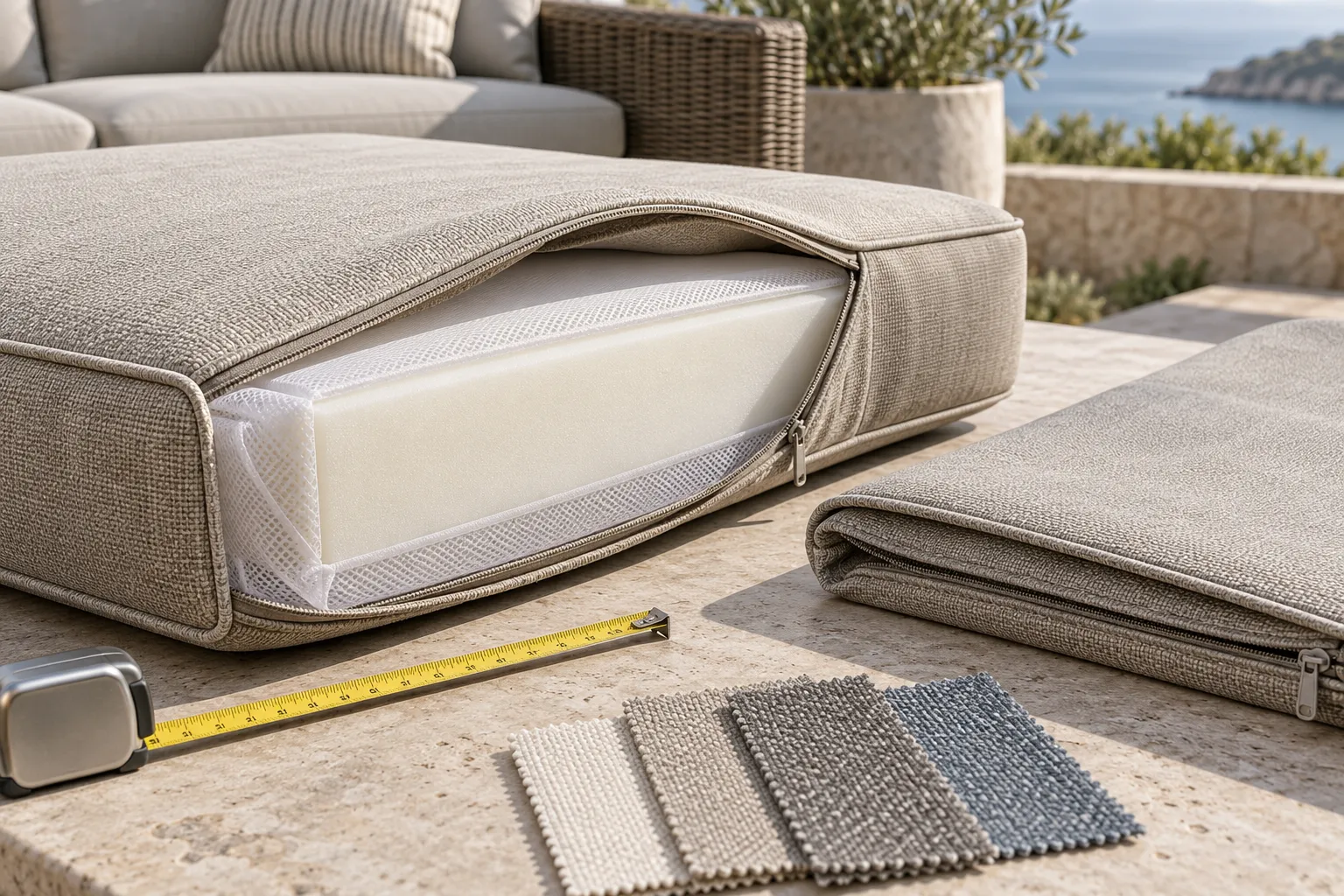
How Should I Measure for Replacement Outdoor Cushions?
Use the original drawing or specification whenever possible. If it is unavailable, measure both the existing cushion and the furniture frame.
Record:
-
Maximum finished length and width
-
Front, center, and rear thickness
-
Corner radius or shaped edges
-
Tapered, curved, or angled sections
-
Zipper and seam positions
-
Ties, straps, clips, and fixing points
-
Seat, back, left, right, or corner position
-
Clear space inside the frame
Photograph the tape measure in place and label every cushion. For a sectional sofa, make a simple top-view diagram so left-hand, right-hand, middle, and corner cushions are not confused.
Do not rely only on an old cushion that has become compressed or distorted. Compare it with the actual frame opening and, if possible, the original production dimensions.
How Can I Identify the Correct Replacement Part?
Start with the original supplier or manufacturer. Provide as much traceable information as possible:
-
Original order number and purchase date
-
Product name, model, or SKU
-
Front, side, and close-up photos
-
Photo showing where the part is installed
-
Part dimensions in millimeters
-
Tube profile or mounting-hole spacing
-
Thread diameter, pitch, and length for fasteners
-
Material, color, and finish
-
Left-hand or right-hand orientation
-
Required quantity
If the original supplier cannot provide the part, a custom replacement may be possible. However, the replacement should be evaluated for fit, load, corrosion resistance, movement, and safety—not only for visual similarity.
Why Exact Material and Finish Matching Can Be Difficult
Even when the original specification is known, a new component may not look identical beside an older one. Outdoor exposure gradually changes fabric color, surface gloss, wood tone, rope, and synthetic weave.
Possible solutions include:
-
Replacing all cushion covers within one visible seating group
-
Using a deliberately coordinated contrast color
-
Requesting a physical fabric or finish sample
-
Comparing samples in the real outdoor light
-
Replacing symmetrical parts as a pair
A supplier should explain when a close match is possible and when natural aging makes an exact match unrealistic.
Which Parts Should Not Be Replaced Without Proper Technical Review?
Safety-related and structural components require additional care. These may include:
-
Cracked or deformed frame sections
-
Major welded joints
-
Load-bearing brackets
-
Reclining mechanisms
-
Gas-assisted or spring-loaded components
-
Large glass, stone, ceramic, or sintered-stone tabletops
-
Umbrella mechanisms and weighted bases
-
Parts connected to electricity, gas, fire, or outdoor kitchens
Do not substitute random fasteners or mechanisms simply because they appear to fit. Incorrect material, thread, grade, length, or corrosion resistance can create a safety problem. Structural repairs should be assessed by the manufacturer or a qualified professional.
When Is Buying a New Set the Better Choice?
Replacement may not be economical or safe when:
-
The frame is cracked, badly bent, or unstable.
-
Corrosion is extensive or hidden inside multiple joints.
-
Several materials are failing at the same time.
-
Replacement parts are no longer compatible or available.
-
The repair would cost close to a new set without providing comparable service life.
-
The furniture no longer fits the space or intended use.
-
The product has a safety-related defect that cannot be reliably repaired.
Before discarding the full set, check whether sound modules, tables, or chairs can still be reused separately. Follow local recycling and disposal requirements for metal, foam, fabric, glass, and composite materials.
Replacement Cushions vs. Buying New Furniture
| Situation | Replacement may be better | A new set may be better |
|---|---|---|
| Strong frame, faded fabric | Yes | Usually unnecessary |
| Flat or uncomfortable foam | Yes | Usually unnecessary |
| Missing feet or connectors | Often | Rarely |
| Localized rope or wicker damage | Sometimes | If repair cannot be matched safely |
| Severe frame corrosion | No | Yes |
| Cracked load-bearing structure | No, unless professionally repaired | Often |
| Multiple components failing | Compare total cost and expected life | Often |
| Furniture no longer fits the project | Limited benefit | Yes |
How Can Buyers Make Future Replacement Easier?
Think about serviceability when buying the original furniture:
-
Choose removable, zippered cushion covers.
-
Keep the approved drawings and final specifications.
-
Record fabric, finish, foam, rope, wicker, and hardware codes.
-
Keep product labels and order numbers.
-
Ask whether consumable parts can be reordered.
-
Select modular furniture when the layout may change.
-
Store a small quantity of matching fabric only when appropriate and properly protected.
-
Follow cleaning and storage instructions to reduce premature wear.
For commercial projects, a spare-parts list can be discussed before the order is finalized. The exact scope, quantity, price, and availability should be confirmed in the contract rather than assumed.
What Information Should I Send to the Supplier?
Use this checklist when requesting replacement cushions or parts:
-
Order number or product model
-
Full product photograph
-
Close-up of the damaged or missing component
-
Installation position and orientation
-
Dimensioned photos or drawing
-
Material, finish, and color
-
Quantity required
-
Description of how the damage occurred
-
Delivery country and postal code
-
Whether installation guidance is required
Ask the supplier to confirm compatibility, included items, expected color variation, installation method, price, production time, shipping method, and warranty terms before payment.
How SIGMA Approaches Replacement and Customization Requests
For SIGMA furniture, buyers should first provide the original order information, product photos, measurements, and details of the required component. The team can then check whether a matching or customized solution may be available based on the product construction and approved specifications.
Availability, exact color matching, price, production time, shipping cost, and warranty coverage depend on the individual product and order. These details should be confirmed before replacement production begins.
Founded in 2005, SIGMA provides one-stop indoor and outdoor furniture solutions for villas, hotels, resorts, modern homes, and commercial projects. Considering future maintenance and component replacement during the design stage can make a customized furniture project easier to manage over time.
Need help identifying a cushion or part? Send SIGMA the product photos, measurements, original order information, and delivery location for evaluation.
Website: https://www.furnituresigma.com/
Related News




Contact US
Product Information
Quantity
Unit
Piece
Support order samples, customization, wholesale direct, and complete payment. If the product you look for does not have corresponding customized content, pls fill out the form below to contact us, and we will reply ASAP.